

Then & Now
Local Residential Schools
September, 2025
One of the saddest and most deplorable chapters in Canadian history was the establishment and operation of the residential school system, a joint initiative between Christian churches and the federal government to educate and assimilate indigenous children into mainstream society. But for more than 150 years, it disrupted First Nations, Inuit and Metis cultures, ripped apart families and communities, and inflicted tremendous physical and psychological damage on residents and descendants who still feel the pain from that experience.
Treatment of some 150,000 students at the schools over the years was barbaric, as the residents were cut off from their families, and endured a regimen of arduous chores, a strict curriculum designed to nullify their cultural roots, and harsh discipline to keep the children in line. Roughly 6,000 children died under the care of residential school administrators.
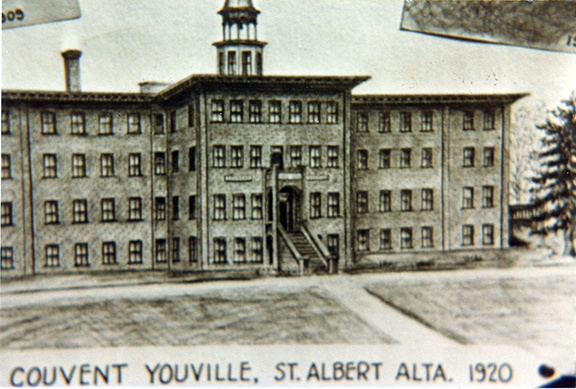
Of the approximately 130 schools that operated in Canada from 1831 to 1996, two of them were located near St. Albert. Here’s a brief timeline of their existence in this region.
1870s-1890s
Established near the banks of the Sturgeon Valley in 1873, the St. Albert Youville Residential School was an offshoot of a Roman Catholic school that had been housing Metis students for four years in Lac Ste. Anne.
The establishment—also referred to as the St. Albert Orphanage and the St. Albert Boarding School—originally consisted of a log cabin that accommodated seven indigenous students, although construction eventually began on other structures. While run by the clergy, the school also received funding from the provincial government.
1900s-1920s
Shortly after the turn of the century, Youville expanded to include a four-storey wooden complex complete with classrooms, dormitories and office. In 1909, construction was completed on a three-storey brick building with a basement to accommodate more classrooms and dorms as well as a space for “dietary services.”
During the 1920s, a spike in enrolment at Youville warranted the building of another brick structure for classrooms, dormitories, staff living spaces, dining rooms and a kitchen. Two additional structures for recreation and outdoor dining also sprung up on the premises.
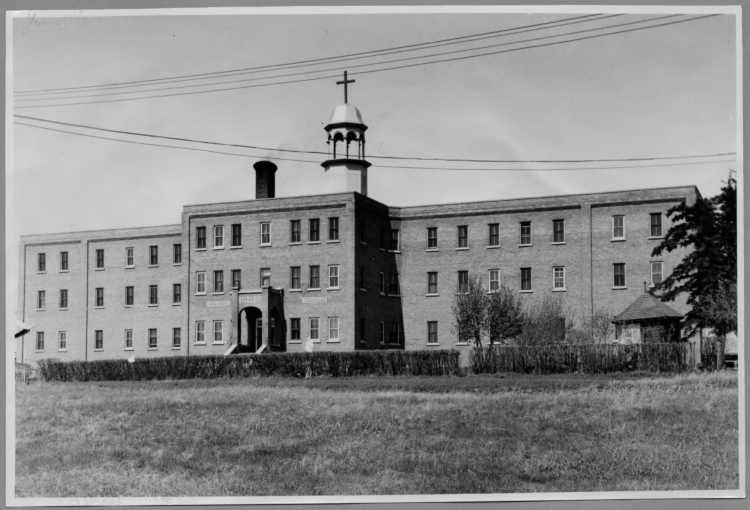
Meanwhile in 1924, The Edmonton Indian School opened near St. Albert in 1924, a reincarnation of a Methodist Church-run industrial school that closed five years earlier in Red Deer. Also known as the St. Albert Indian School, it consisted of a three-storey brick complex complete with classrooms, dormitories, and administrative offices taking up much of the space. It was also outfitted with dining and recreation rooms, kitchen and laundry facilities and a chapel. Additional functions that the building couldn’t contain were housed in a barn.
1930s-1940s
At its peak during the 1930s, Youville housed more than 250 indigenous residents. While most of them attended the facility, some of them apparently received their education at a public school nearby. During the 1947/48 academic year, 130 students lived on the premises, before the school was permanently shuttered June 30, 1948.
During its first decade of operations, most of the students in the Edmonton Indian School came from areas surrounding the provincial capital, but by the 1930s, more indigenous children were shipped in from northern British Columbia.
1950s-1960s
The Edmonton Indian School greatly expanded its reach during the 1950s, when more indigenous children arrived from not only B.C., but the Northwest Territories and the Yukon as well, swelling its attendance to 178 students, an all-time high for the facility. Older residents attended junior and senior high schools nearby until the residential facility boosted its instruction to include Grades 5 to 12 in 1958. Apparently, that endeavour didn’t last very long, as by September, 1960, all of the residential school’s students wound up occupying classrooms at schools in Jasper Place in Edmonton’s west end.
During the 1960s, the United Church was involved in sending indigenous students to the school, but that venture was short-lived when the federal government stepped in to operate the school in 1967. On June 30, 1968, when attendance has shrunken down to 47 residents, the school was shut down.
Today
Nothing remains of the Youville complex. The main building of the Edmonton residential school burned down in 2000, although the site eventually became Poundmaker Lodge, the country’s first aboriginal addictions treatment centre, still operating today. But what hasn’t gone away are the painful memories and recorded anecdotes concerning the fate of many of its residents.
The National Centre for Truth and Reconciliation came up with a list of 47 students who died at Youville and nine who perished under the care at the Edmonton complex, although speculation is rampant that more fatalities are unaccounted for.
One person who could recall first-hand the effects of those tragedies was former Edmonton school resident George Brertton, who eventually became an instructor at Blue Quills First Nations College. He recalled one time when he and classmates had to bury some of the children who died at
the school.
“I had a lot of nightmares about that. We had to dig these holes so far down,” said Brertton to the Edmonton Journal in 2003. “I remember yelling and screaming in my sleep because I thought I was going to get buried in one of those holes.”
Just as vivid are the memories of Emma Rayko, who attended the same school. “For eight years I suffered in that damn school,” said Rayko to Lakeland Today in 2020. “You suffer in those schools…. for no reason. You are walking in the hallway, and one staff member is standing there—you are not doing nothing and you get slapped for nothing, and you don’t understand.”
Hoping to foster understanding of what happened to the residents, parties involved in the Indian Residential Schools Settlement Agreement, under the jurisdiction of the federal government, established the Truth and Reconciliation Commission in 2008. Seven years later, the Commission issued several calls to action, while declaring that the actions committed by the government and residential school administrators amounted to what it call a cultural genocide


More Then & Now

Join the T8N E-Newsletter